
Asia-Pacific Conference on Wind Engineering (APCWE10)@中国で研究発表を行いました
2025年8月15日~19日に中国の成都で開催されたThe 10th Asia-Pacific Conference on Wind Engineering (APCWE10) にて,松宮准教授,野口助教,学生2名が研究発表を行いました.本来は2021年に予定されていた会議でしたが,COVID-19の影響のため延期されていました.専門性を有する国際会議への参加を通じて,有益な情報収集や交流ができました.
Dr. Matsumiya,Dr. Noguchi, and two students made presentations in the 10th Asia-Pacific Conference on Wind Engineering (APCWE10) held in Chengdu (China) from August 15 to 19, 2025. The conference was originally scheduled for 2021 but was postponed due to the impact of COVID-19. Through participation in international conferences of a specialised nature, we were able to gather useful information and exchange ideas.


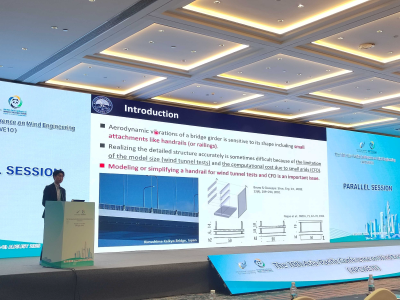
Runze XU
Vortex interference effects in flow-induced vibration of a rectangular cylinder with various vertical plates
The presentation itself was well done, but I think the introduction of my research background should be easier to understand in the future presentation. It is my first time attending a professional international conference about wind engineering, and I had the opportunity to get in touch with the research progress and results of other branches of wind engineering.
For example, Prof. XXXX gave me a new idea to see and think about the questions in our study and life, and everything can be seen in a 'harmonic oscillator' way. A new perspective on a problem is one of the important conditions for reaching new conclusions and helps us deepen our understanding of the problem. Then, Prof. YYYY's presentation reminded me of the importance of long-term maintenance for bridges. The decrease in structural damping after several years and changes in the atmospheric wind environment in the future will probably bring new challenges to previous wind-resistant designs. And regarding the wind environment, Prof. ZZZZ gave me a deep impression about the influence of air pollution on the wind field change around the world in the future. Fine particles in the air probably also have a significant impact on wind conditions. Besides the relatively traditional discussion about wind resistance design through experimental tests and CFD, the use of AI seems to be more widely used in wind engineering. Whether it is the prediction of wind environment, the prediction of wind-resistant design results, or a series of active wind-resistant designs, AI has broad application prospects.
What’s more, in the academic tour, I was deeply impressed by the detailed 3D-printed models and the experiments with the full-bridge aeroelastic model. In addition to the academic gains, I also made many like-minded friends. Sharing insights on research and life with them has been incredibly rewarding. I hope to have more opportunities to participate in similar academic activities in the future.
Thet Ei
Interval and length effects of discrete fairings on torsional aerodynamic vibration
This was my first time presenting at an international conference, and I was very excited before going to China. I had prepared my presentation slides a month in advance and practiced thoroughly. Upon arriving in China, we stayed at the hotel where the conference was held. On August 15th, after completing the conference registration, we visited the Wind Engineering Research Center at Southwest Jiaotong University, where they explained a wind tunnel test for the aeroelastic model of XXXX Bridge. I was fascinated by the 3D model, although I noticed that some suspension cables were loose while others were tight. When I asked whether this affected the results, the students explained that it was fine since the cables were only meant to represent stiffness. After the tour, we returned to the conference.
The next morning, keynote lectures were given by Professors from various universities. I had the good opportunity to meet many professors and researchers from around the world, as I aspire to work as a researcher or scientist in the future before pursuing an academic career. The conference officially began on August 16th, and I found the presentation by the Ph. D student from YYYY University was particularly interesting. He used ETABS software for structural design and then validated the mode shapes obtained from the software with wind tunnel test results. Additionally, he employed numerous pressure tabs to examine wind pressure variations over the building. This made me realize that I could also incorporate structural software into my future research in wind engineering, especially since I am already familiar with such software from my master’s thesis on building design.
My presentation was scheduled for August 17th. I had practiced it at least ten times because I wanted to do my best at my first international conference. During the presentation, I felt both excited and nervous, and my voice was loud and strong. However, in the Q&A session, I answered one question too directly and gave an incorrect response. Then, I realized that I should have taken more time to think before responding and provided more careful, indirect answers. After my presentation, ZZZZ came up to me and complimented me that my presentation was very nice. Later, I also approached the professor who had asked me a question and apologized for my wrong answer, explaining that I was nervous at the time. He reassured me not to worry, and I felt relieved.
The next day, we had dinner with Wang-san, a visiting researcher of our lab last year who also presented at this conference. Afterwards, he took us to Chengdu Wuhou Shrine. It was my first time seeing Chengdu at night, and the city was lively and bright with lights. During the conference, I made friends with students and researchers from around the world. I also met many students from different universities in China and asked for my WeChat account to stay in touch after the conference, but due to technical problems, they were unable to add me. Nevertheless, everyone I met was very kind and friendly, even though it was our first meeting. This was truly a special experience for me, and it has strengthened my motivation to continue my research and present at more conferences in the future.